Why it Matters
Across Australia, older women are one of the fastest-growing groups experiencing housing insecurity and homelessness. Many have spent a lifetime working part-time or caring for others, often with interrupted employment and limited superannuation. Others are propelled into crisis by events such as divorce, relationship breakdown, illness, job loss, or the death of a partner. While the public image of homelessness is still shaped by rough-sleeping men, the reality for older women is usually hidden: staying with relatives, couch-surfing, or sleeping in their car when no other options exist. Many have never been homeless before.
At the same time, housing stress has intensified. More than half of lower-income renters now spend over 30% of their income on housing, compounding financial pressure and eroding wellbeing. Community organisations have begun expanding housing support programs in response, although there is limited evidence about how these interventions work, where they fall short, and how they can better support long-term stability for older women.
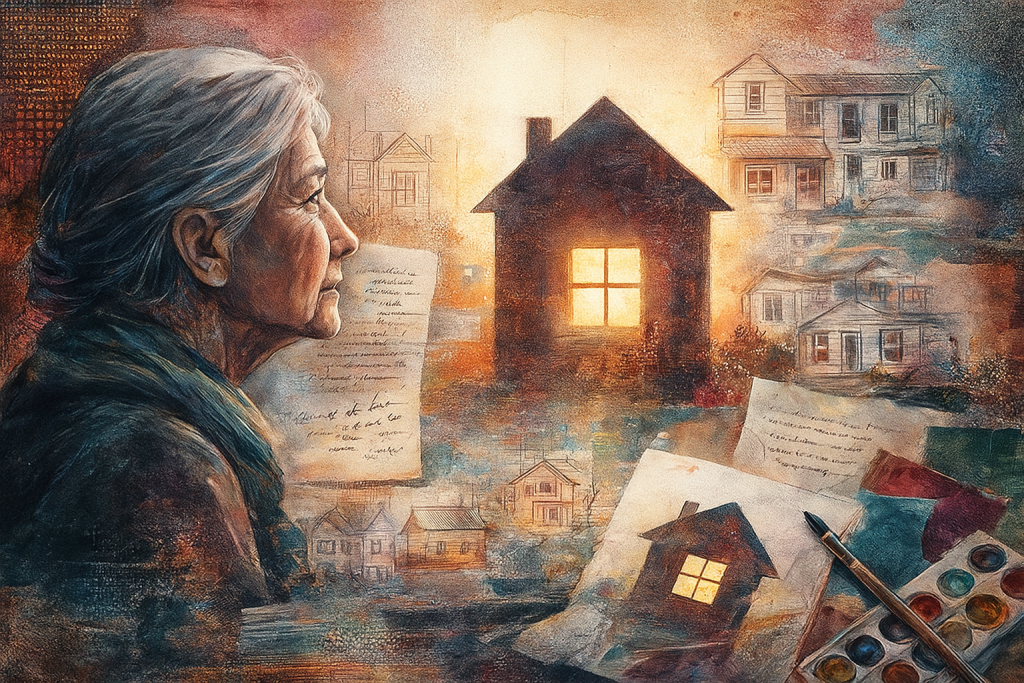
This project responds to that gap. In partnership with Footprints Community, we are evaluating a housing support program for women aged 55+ who are experiencing, or at risk of, homelessness. Alongside this evaluation, we are using arts-based research and arts-based knowledge translation to document women’s lived experiences: in their own words, images, and stories, to share those insights with the wider community.
Project Overview
This project brings together evaluation and creative storytelling to better understand how housing support programs can meet the needs of older women at risk of homelessness.
Understanding what works
We are working with Footprints Community to learn how their housing support program helps women aged 55+ find stability and rebuild their lives. By speaking with women who have used the program, as well as the staff who deliver it, we aim to understand:
- what parts of the program are most helpful
- where improvements could be made
- how support services can strengthen long-term housing security
Sharing lived experiences through the arts
Alongside the evaluation, women will have the option to share their experiences through creative methods such as photography, writing, poetry, and digital storytelling. These artworks will become part of a public exhibition designed to:
- give voice to stories that often go unheard
- challenge common stereotypes about homelessness
- help the community better understand the realities older women face
A safe and supportive process
The project is guided by a trauma-informed, participatory approach. This means we place safety, respect, and choice at the centre of every activity. Creative methods offer women a way to express their experiences in their own style and at their own pace, while the evaluation helps Footprints strengthen and improve the support they provide.
Together, these approaches allow us to build a fuller picture of both the challenges and the strengths within this community – and to turn those insights into action.
Funding/Grants
This project is funded by Footprints Community.
Project Team
Chief Investigators
- Professor Evonne Miller
- Associate Professor Elliroma Gardner
- Associate Professor Sean Maher
- Dr Ruari Elkington
- Professor Donna Hancox
- Dr Andrea Blake
- Dr Lyndall Bryant
- Professor Lisa Scharoun
- Professor Rowena Maguire
- Dr Jack Adams
Research Support
- Leonie Sanderson
- Jess Greentree