Stories that leave an impact aren’t the ‘what’ stories filled with standards and benchmarks (Parr, et al., 2015). Rather, it’s the ‘who’ stories – those that offer an insight into the storyteller themselves – that truly connects a reader and enables an authentic view inside their world. Move 3 helps us do this by refining our stories for our reader to allow that connection and leave an impact.
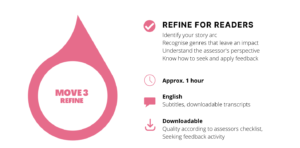
Refining for your reader
Sometimes, we write in a way that doesn’t clearly communicate to our ideas or explain our achievements. This can be because we are trying to ‘sound formal’ or because we forget that our readers don’t have the same knowledge and experience as us.
Re-reading your draft as if you are a new reader is a good way of making sure your draft is powerful and clear, and connects with your readers. It can help you spot and remove text that waffles, is repetitive, too full of jargon, and sentences that will be difficult for readers to engage with. Re-reading can also help you see sections that appear to be a ‘shopping list’ of different ideas that don’t connect with the narrative you want to tell.
For teachers, we can think of many times when we have marked student work that was full of long sentences and ideas that were too busy. Can you remember reading student writing that left you wondering what the student was trying to communicate? Can you remember how frustrated you felt?
Checking that you have crafted a reader’s version of your text means readers and assessors do not have to make assumptions and can clearly read your contributions and impact.
How do I organise my story/ what genre do I use?
In this short video, Leanne talks with Kami about finding the right arc of her story and the types of genres that might support them:
Download video transcript here.
In general, your story will look more like a news story than a fairy tale. In a fairy tale, we hear all about the events before we get to the story climax. In a news story, we are hit with the impact first, and then read on to find out the details. Your reflexive practice will help you to create this structure.
Lasting impact is not easy to achieve. Stories of impact will often be complex or told over several stages. Your reader needs to be able to see the big ideas without having to work too hard. That is why it can help the reader if you use a familiar genre. If a reader is used to the structure of the story, they will be able to give more attention to what the story is about.
Here are four types of genres that could be used to tell your story. These have been recognised as the easiest for readers to follow and therefore helps articulate your impact:

There may be other genres you can use. You can also draw on a few different genres within one portfolio. The idea is to choose a story structure that meets the type of story that you want to tell your reader and one that reflects you as the storyteller.
When crafting their own story, one teacher explained the various genres that they used when sharing different claims: “The action research narrative, which was my mentoring activities. There was a personal growth narrative which was my Indigenous perspectives, and then there was a project management narrative, which was my eSmart. So if I had’ve known that that’s what I was doing when I started I would have had a better idea of how to structure it.”
How do assessors view your story?
Assessors report that a quality portfolio makes the evidence of impact explicit to the reader by using a well-structured narrative, clearly annotated the evidence, adopting the language of your professional standards (i.e. APSTs) and including concise evidence of reflexive practice.
Assessors report that it is faster to make judgments about the quality of evidence when candidates use similar language detailed by their professional standards, such as the APSTs.
For teachers, it is important for candidates to discuss their school context, outlining how they demonstrate leadership within the parameters of their school context.
Assessors make overall judgments by looking for links between:
- evidence about the students and the selected learning goals,
- the learning goals and the learning activities, materials and resources,
- the learning goals and the methods of monitoring and assessing student learning, and
- the teacher’s analysis and reflection of their teaching and the evidence of their students’ learning
Listen to Rebecca and Leanne reflect on what HALT assessors look for:
Download video transcript here.
To see if your evidence aligns with the expectations of assessors, use this checklist: Quality according to assessors checklist
For teacher candidates, use this document to learn more about what HALT assessors are looking for: Assessors’ Recommendations to HALT Candidates
Getting feedback
There are two very good reasons to ask a peer to give you feedback on a draft:
(1) we are often our own harshest critics and can be reluctant to explain our successes, and
(2) we sometimes forget to give a ‘readers’ version’ of our story that clearly explains our achievements and links them to the standards.
Having a peer provide work can help you pinpoint where your can strengthen your application.
We often find it hard to write about ourselves, and cringe at the thought of clearly explaining our successes. Sometimes, we are so busy that we forget the important contributions we have made over the years. Having a peer review your work can often help overcome this challenge because they are familiar with your successes and can point out achievements that could be included to strengthen your submission.
Sometimes we all suffer from ‘the curse of knowledge’. We know what we are thinking and forget that others haven’t got the same knowledge or experience as us. For example, others may not be familiar with the pedagogical framework that you know inside out. A link to a particular standard might seem obvious to you but a peer might help you to see that others can’t see that same link. Asking a peer to provide feedback will help ensure you are providing a ‘readers’ version’ that clearly articulates your achievements and is clearly linked to standards.
Put it into practice
Write: using your claim from Move 2 and the knowledge of reflexivity, start writing a story inside one of the genres listed in this Move. If the story does not flow, change genres and try again.
Share: use this Seeking feedback activity with a trusted colleague to receive intentional feedback and ideas on your story and its evidence.
Plan: set a date for when you’d like to submit your application. Ensure that the date provides enough time to gather evidence and allows you to be reflexive. Remember, the stories that leave an impact require careful and intricate weaving by their storytellers.