Last week the Regional Arts and Social Impact research team launched the final report for the ARC Linkage Project The Role of the Creative Arts in Regional Australia: A Social Impact Model at the headquarters of our project partner, the Regional Australia Institute. We are delighted to now publicly share this report.
This ARC Linkage addresses the long-standing problem facing rural, regional and remote communities in Australia of how to strategically communicate and effectively evaluate the social impacts of the creative arts in communities. The findings articulated in this report indicate that arts and cultural projects and programs are profound drivers of community thriveability by attracting workforce, and improving wellbeing, employment and tourism opportunities. These findings emphasise that particularly in rural, regional and remote communities the social, cultural and economic outcomes of engagement with arts, culture and creativity are entwined.
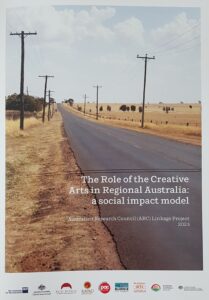 The report offers a proposed language frame that may assist rural, regional and remote communities to identify success markers resulting from engagement in arts, culture and creativity. The frame and contents of this report suggest ways in which Australian communities can meet the challenge of measuring the value of the creative arts, and proposes a way forward to adequately articulate those values.
The research points to four significant outcomes that may be used to understand the social impacts arising from engagement in arts, culture and creativity. These outcomes are expressed as: Collective Wellbeing, Thriving Communities, Amplified Place, and Creative Ecologies. These four frames, defined and described within the report, should not be viewed as static language or a fixed understanding of the concept. Rather, the frames and concepts are suggested starting points for Australian rural, regional and remote communities and organisations to begin articulating the social impacts of the creative arts for individuals and whole communities.