Many countries around the world are working towards making their health service more age friendly. Let’s take a look at the tools that these countries have been using to make more age friendly health services:
New Zealand’s Positive Ageing Strategy1

New Zealand has been working on their age friendly strategies since 20011, with their health services goal focusing on equitable, timely, affordable and accessible health services for older people.
As of 2014, New Zealand’s achievements in improving the age friendliness of their health services included;
- Improving access to residential care for people in need, especially with dementia,
- A falls prevention program,
- Support for living in own homes,
- Health professional training,
- Health and well-being programs for older people,
- Better clinical assessment tools for home care and aged care residential programs.
Institute of Healthcare Improvement (IHI) United
States of America2
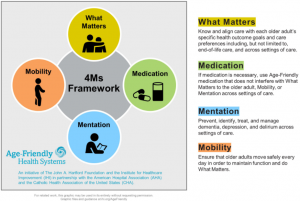
The Institute of Healthcare Improvement has a focus on creating age-friendly health systems in the United States. The IHI has identified four key guiding principles that recognise age friendly health services as a system where older people get the best possible care, experience no health-care related harms and are satisfied the health care they receive2. This is the “4 M” model:
- What Matters: Aligning health care to health outcome goals and care and knowing what matters for current future and end of life care.
- Medication: Medications that do not interfere with the other 3 M principles including mobility and dementia prevention; implement standard processes for age friendly medication reconciliation and de-prescribe and adjust doses to be age-friendly.
- Mentation: Ensure adequate nutrition, hydration, sleep and comfort; maximise independence and dignity; identifying and preventing dementia, depression and delirium across care settings.
- Mobility: Ability to move safely to function and do ‘what matters’ with an individual mobility plan and an environment that enables mobility2,3.
We can look at what is being done globally and use this knowledge to tailor our own age friendly health services here in Australia.
Global and International Tools
The WHO outlines key areas for consideration, based on a series of international consultations, for age-friendly health and community services. A checklist is provided by the WHO4 and includes:
Accessible Care
Areas included under this theme include;
- Location and accessibility
- Transportation
- Availability of services for emergency care
Checklist items for accessible care include:
- Distribution of health and social services
- Purposeful dwellings for older residents including residential aged care and nursing homes located close to health and social services
- Services are accessible for people with disabilities
- Information is clear
- The services are delivered within minimal bureaucracy
- There is respect for older people from all staff
- Economic barriers are reduced
- For the end of life, burial sites are designed with adequate access
Offer of services
- The range of health services is adequately offered
- There is home care available
- The needs and concerns of older people are addressed through services
- Staff have training and skills in age-friendly health services
Voluntary support
- That volunteers are supported to assist older people in the community
Emergency planning and care
- That the needs of older people in emergency care are accounted for
1. Office for Seniors Citizens (2015). 2014 Report on the Positive Ageing Strategy Office for Senior Citizens: Wellington. http://www.superseniors.msd.govt.nz/documents/msd-17470-2014-ageing-strategy-report-final.pdf
2. Institute for Healthcare improvement (IHI) (2019). Age friendly health systems. http://www.ihi.org/Engage/Initiatives/Age-Friendly-Health-Systems/Pages/default.aspx. Accessed 5 April 2019.
3. Mate KS, Berman A, Laderman M, Kabcenell A and Fulmer T (2018) Creating age-friendly health systems – a vision for better care of older adults Healthcare 6 (2018) 4-6. http://dx.doi.org/10.1016/j.hjdsi.2017.05.005
4. World Health Organization (WHO) (2007). Checklist of essential features of age-friendly cities. https://www.who.int/ageing/publications/Age_friendly_cities_checklist.pdf