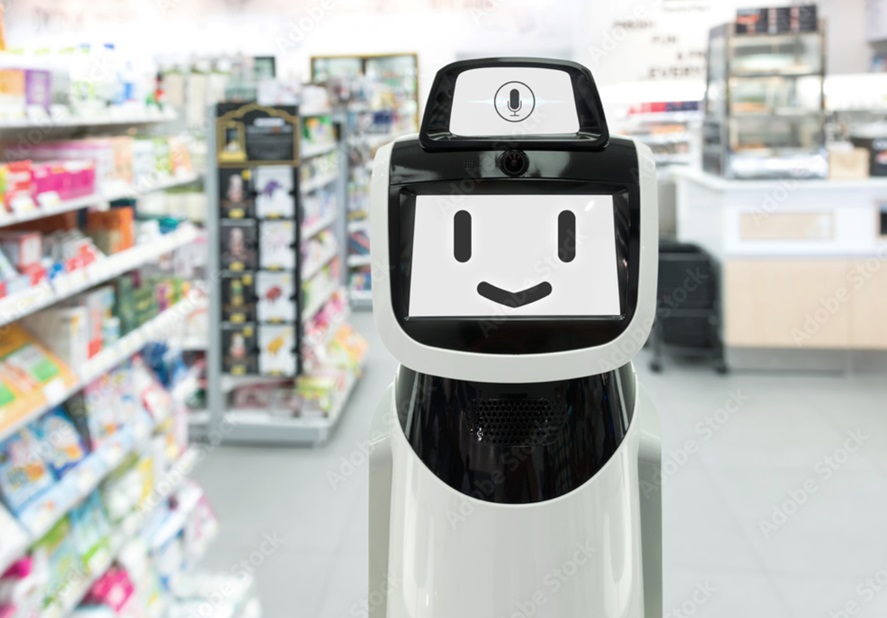
Retailers have increasingly used artificial intelligence (AI) innovations to enhance customer experience, for example, humanoid social robots (HSRs) – robots designed to interact with humans in a human-like manner. Along with that comes the idea of speciesism in which humans often assume ourselves to be superior. Therefore, this paper investigates the effects of AI and speciesism on consumers’ perceptions of robot sales assistants.
This research responds to research calls to adopt a human-like perspective to understand the compatibility between humans and robots and determine how personality traits like speciesism affect people’s acceptance of human-like robots. In addition, regarding the lacking empirical evidence, this is the first study to examine the influencing role of speciesism of customers’ views of robot retail assistants and also the first to showcase that speciesism can positively influence people’s decisions to engage with human-like robots. Three hypotheses were developed accordingly.
Method and sample
The research includes three online experiments to test the effects of robots’ intelligence on customers’ perceived competence and willingness to choose a store with sales assistant robots for purchase decisions. They involve two main conditions: robots’ high intellectual intelligence vs. robots’ low intellectual intelligence. Participants were recruited via Prolific in the US in exchange for £1.05.
Study 1, with a sample of 372 participants, examines how speciesism influences the impact of the robots’ intelligence on customers’ decisions to shop at stores with assistant robots. Study 2 demonstrates that Study 1’s effect is shaped through the perceived competence of the robots, with 119 participants. Study 3 integrates the findings of Studies 1 and 2, examining the roles of both speciesism and perceived competence in how the robots’ intelligence influences consumers’ decisions to engage and purchase in-store, with 396 participants.
Key findings
- People with higher speciesism will be less likely to tolerate another species that is not at their level in the retail environment. Hence, these speciesists will prefer to engage with robots with higher level of human-like intelligence and are more likely to make a purchase at the store in this case.
- When highly intelligent robots interact effectively with customers as sales assistants (e.g., being able to answer all the questions about different products), customers perceived those robots as more competent. This positively influences purchase decisions.
- Speciesism reduces customers’ perceived competence of retail services robots, especially in case of ones with lower intelligence. When the robots’ intelligence does not satisfy customers with high speciesism, the robots will be perceived as highly incompetent, which results in the customers’ avoidance to engage and purchase.
Recommendations
Retailers should identify the traits of human-like robots that affect customers’ acceptance in frontline retail settings. Managers should understand how speciesism can influence customers’ willingness to engage with the robots and “employ” robots that can replicate the intelligence of human staff. Successfully doing this will allow customers to experience an enhanced in-store shopping experience and make them feel that they are interacting with well-trained and efficient retail staff.
Moreover, retailers may develop educational marketing campaigns and communication strategies on what customers should expect when expecting with sales assistant robots, which will help establish performance expectations and strengthen the robots’ perceived competence. For example, promoting the robots’ specific roles and how customers could most effectively interact with them to enhance the in-store shopping experience.
It is also important to pay attention to customers with a high perception of human uniqueness and segment those customers for more effective targeting. In addition, it is suggested that managers select employees with high-level speciesism to actively support the development process of human-like sales assistant robots. Moreover, retailers can assign human staff to work alongside robot assistants and educate customers on how to best interact with these robots to optimise their experience.
Researcher

More information
The research article is also available on eprints.