Macro-Cage Build One – Handmade Wooden Supports
After unboxing the StackShot rig, we placed our kit items on a tabletop and confirmed everything was operational by perusing the system manual, connecting cables, controller and motors, then having a tinker. To be honest, this first build was not really all that cage-like but aside from enabling initial experimentation, it clearly demonstrated that adding a cage into the mix would be beneficial enough to warrant some additional fabrication.
We adopted a minimalist approach to Build #1 by opting to deploy just the rail for x-axis stacking plus a single horizontally-mounted rotary table to automate the rotation. But looking at the components sitting loose on a table it was clear some additional stability was required – so we added a simple but solid wooden base to each of the moving parts.
Mounting threads for StackShot components follow the film/video standard of US (not metric) measurements with both 3/8 inch” and 1/4” holes available. To enable screws to be recessed in the underside of each base we used a 15mm Forstner bit followed by a standard bit to complete the assembly preparation. We also routed a small circular turntable top out of 3mm MDF, drilled a counter-sunk hole in the centre and mounted that on top of the rotational assembly.
Software pre-installed onto the StackShot embedded controller is purpose-made for focus-stacking so we selected X-stack + Y-rotate mode, set the specified number of steps required to achieve an adequate stack, and decided on our rotational increments in degrees (kicking off with 10 = 36 steps per 360°). Learn more about that process here.
With a simple rig like this one, everything is effectively free-standing including lights and background. Rotating and Stacking elements were placed horizontally a suitable distance apart with stacking rail and camera shimmed manually with pine supports to center lens height on our turntable-mounted object.
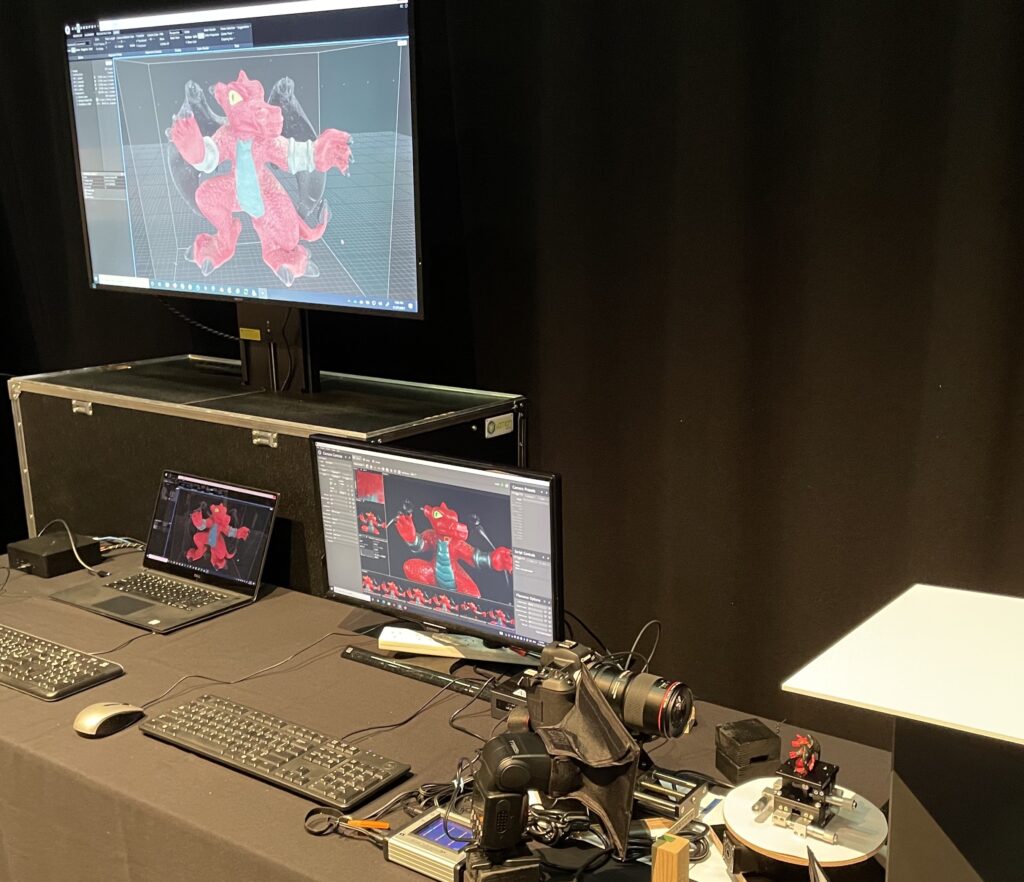
Initial testing was conducted with continuous lighting and later small flash units were also tried. Mounting for these was either on the base stands supplied with many units or low-height tripods or gorilla-pods Backgrounds (black or white depending on object) were support on a table-top leaning against a wall. These first trial experiments were conducted with a modest Canon D1300 (18mpx APSC) camera and 18-55mm kit lens with macro-tube extensions.
The downside of all these free-standing elements is the inevitable clutter of mini-tripod legs, cables and equipment supports. So at the conclusion of round one we decided to augment the system with a dedicated macro-cage that would enable us to easily mount rig elements in convenient positions.
{IMAGES: Stackshot bits on table-top, rig elements etc.}