Project Synopsis:
Artificial intelligence (AI) is increasingly becoming a cornerstone in urban services, shaping the trajectory of city development and societal evolution. While AI holds immense promise for enhancing urban innovation, it also poses significant risks when not implemented responsibly. The current landscape often lacks a comprehensive understanding of the costs, benefits, risks, and impacts associated with the deployment of AI systems by governments. This knowledge gap can lead to unintended negative consequences, such as reinforcing existing inequalities or compromising privacy and security.
This project aims to bridge these gaps by equipping local governments with the tools needed to engage with AI responsibly. Our primary objective is to develop detailed best practice guidelines for the responsible adoption and implementation of AI by Australian local governments. These guidelines will emphasise the importance of using AI technologies in ways that promote equitable and sustainable urban planning and services.
To achieve these goals, the project’s conceptual framework adopts a multidimensional approach, integrating community perspectives, policy considerations, and technological advancements. This framework is built around the core values of responsible AI: acceptability, accessibility, alignment with societal values, trustworthiness, and sound governance. By adhering to these principles, the project seeks to create an environment where AI can be harnessed to benefit all members of society while mitigating potential risks.
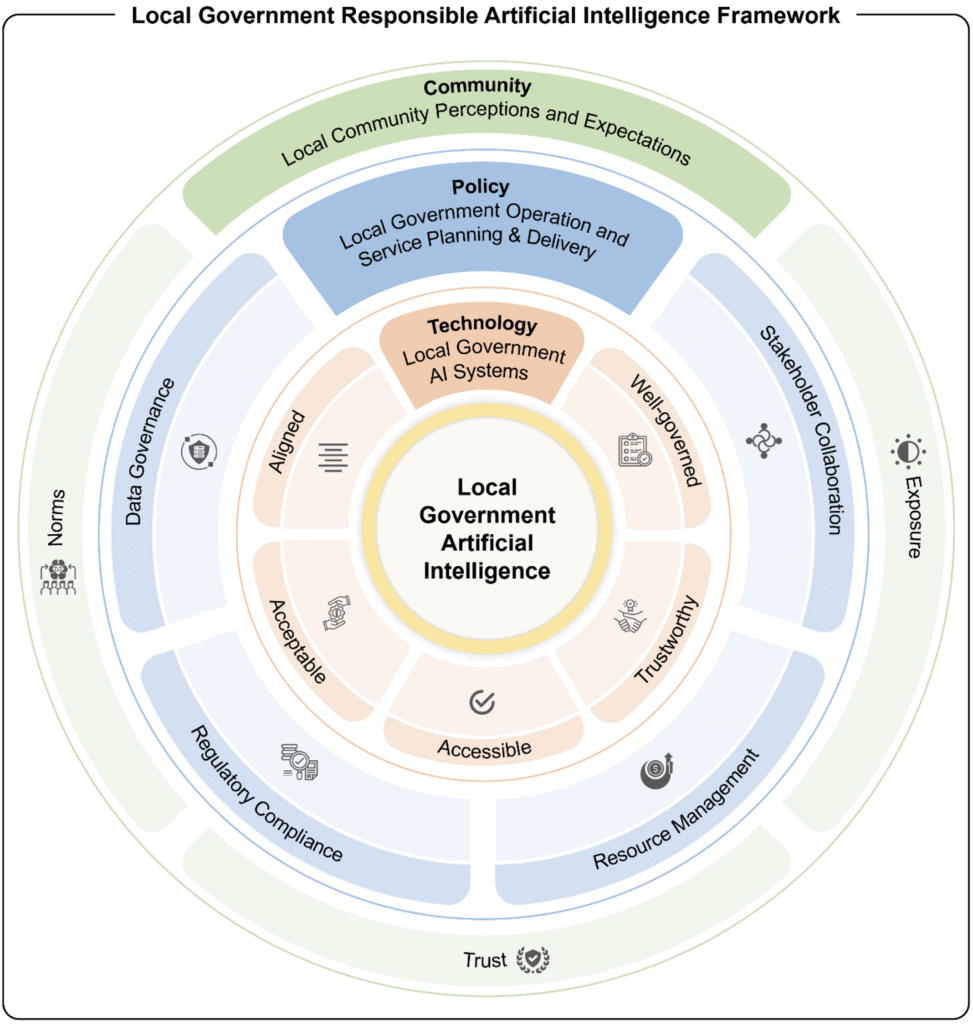
The figure below illustrates the key components and interconnections within this framework, showcasing how these elements work together to facilitate responsible AI integration in urban settings. This conceptual framework highlights the critical role of three key drivers—technology, policy, and community—in developing responsible AI systems within local governments.
At the heart of the framework lies the ‘technology’ aspect, which embodies the essential attributes of responsible AI, including accessibility, acceptability, trustworthiness, alignment, and effective governance. The ‘policy’ aspect acts as a conduit between the development and implementation phases of responsible AI, addressing factors such as stakeholder collaboration, resource management, data governance, and regulatory compliance. Meanwhile, the ‘community’ aspect underscores the importance of understanding and addressing community perceptions and expectations, which may vary based on factors such as trust in local government, exposure to AI, and societal norms regarding AI use.
By effectively integrating and leveraging these three drivers, local governments can successfully promote the responsible integration of AI into the communities they serve, ensuring that technological advancements contribute positively to urban life and governance.
Funding / Grants
- Australian Research Council Discovery Project (DP220101255) (2022 - 2026)
Team
Other Team Members
- Prof Tan Yigitcanlar (Project lead) (QUT)
- Prof Kevin Desouza (QUT)
- Prof Karen Mossberger (Arizona State University)
- Prof Juan Corchado (University of Salamanca)
- Prof Rashid Mehmood (King Abdulaziz University)
- Prof Rita Li (Hong Kong Shue Yan University)
- Prof Pauline Hope Cheong (Arizona State University)
- Sajani Senadheera (QUT)
- Anne David (QUT)
- Raveena Marasinghe (QUT)
- Ke Liu (QUT)
Partners
Other Partners
Partner Organisations:
- Arizona State University
- University of Salamanca
- King Abdulaziz University
- Hong Kong Shue Yan University