Project Description:
This study aims to develop geopolymer concrete (GPC) with recycled waste glass (WG) combined with hemp fibre as carbon-negative substitutes for natural sand. Industrial by-products such as fly ash (FA) and Ground Granulated Blast Furnace Slag (GGBS) are used as binders, activated by combined alkali solution of 10M sodium hydroxide and sodium silicate.
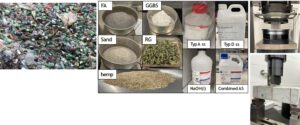
The effects of key parameters including binder ratio (0% FA 100% GGBS, 50% FA 50% GGBS and 100% FA 0% GGBS), silica modulus (2.0 and 2.5 ratios), curing regimes and curing periods on the mechanical properties of GPC are examined at the paste level. 100% GGBS paste specimens reach 61 MPa compressive strength at 28 days. At the mortar level, several variations are examined such as the influence of binder ratio, sand replacement with WG (10%, 15%, and 25% by weight) and hemp (1%, 1.5% and 2.5% by volume). The findings show 15% WG replacement increased its compressive strength up to 78% between 14 and 28 days. The use of hemp with up to 1.5 % replacement produced optimum strength, where higher percentages resulted in strength degradation.
| Project Details:
Duration: 2022 – Ongoing Research Methods:
|
Team: QUT :
Collaborative Partners:
|