Project Description:
Flooding is a recurring global hazard causing significant damages, as highlighted by the UNDRR report. Australia has faced severe flooding episodes recently, like the 2022 Eastern Australia flood, notably impacting Southeast Queensland and causing extensive infrastructure damage. Predictions estimate Australian flood damages at $1-2 billion. Similarly, the UK experienced a major flood in 2009 affecting millions and costing about £1.3 billion. Addressing these challenges, property owners and insurers seek mitigation strategies. Effective solutions arise from understanding infrastructure vulnerabilities.
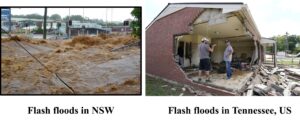
Past flood surveys indicate that masonry structures fail due to hydrodynamic impulsive loads followed by hydrostatic loading from rising waters. Yet, few studies examine masonry responses to these conditions. Addressing this, a 3D finite element model using an anisotropic masonry material model was created to study the collapse of walls during flash floods. This method, validated against experimental data, was expanded to assess masonry walls’ reactions to hydrodynamic pressures. Findings show that initial flash flood impacts significantly weaken masonry, potentially causing early collapse even with slow water level rises. The study also compared masonry walls of two slenderness ratios under flash flooding, determining their maximum resistance to inundation. Emphasis is on the need to account for hydrodynamic loads when designing flood-prone masonry buildings and the model’s utility in assessing such vulnerabilities.
| Project Details:
Duration: May 2023- Ongoing Research Methods:
|
Team: QUT :
Collaborative Partners:
|