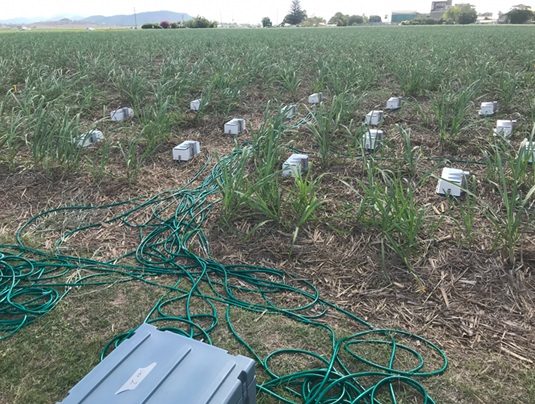
This project aims for optimisation of greenhouse gas (GHG) measurements for low-cost, high-accuracy verification of on-farm carbon footprint reduction, promoting sustainable farming practices and decarbonisation of agri-food industries. On-farm GHG emissions, such as nitrous oxide (N₂O), are responsible for about 50% of the carbon footprint in agri-food industries.
Tackling these emissions through improved farming strategies will significantly reduce the carbon footprint of this sector. However, their efficacy and economic feasibility remain uncertain due to high variability in N₂O emissions resulting from interactions between environmental and management conditions. This large uncertainty hinders evaluation and accreditation of emission reduction across agricultural industries. Verification of N₂O reduction by field measurements is the only way to guarantee credibility of carbon footprint reduction. The current methodologies are, however, prohibitively expensive and/or inaccurate, resulting in the limited adoption and lack of consistent methods to verify emission reductions in the agricultural industries.
More effective emission reduction measures and accreditation are critical for both the agri-food industries and the Queensland government. For the agri-food industries, this is an opportunity to add low-emission values to their agricultural products, gain market access, and ensure competitiveness. Such added values and greater market opportunities for agri-food industries are aligned well with the government’s Strategic Plan 2023-27. The optimised, robust yet low-cost GHG measurement and verification technology to be developed in this project will promote low-emission farming practices and enhance the values of agricultural products with a low-carbon premium in Queensland.
Project team
Project partner
Project funding
More information