Southern Ocean aerosol processes in global models investigated with QUT’s measurements
Marine biogenic sulfur emissions represent the largest source of natural sulfur in the atmosphere with implications for climate and cloud formation. Global chemical transport models (CTM) are able to simulate aerosol formation processes from marine biogenic sulfur emissions in great detail although their fidelity needs to be evaluated against ground truth measurements. One such CTM, GEOS-Chem, has the most up-to-date sulfur chemistry available and QUT offers a wealth of in situ measurements of gaseous and particulate sulfur species.
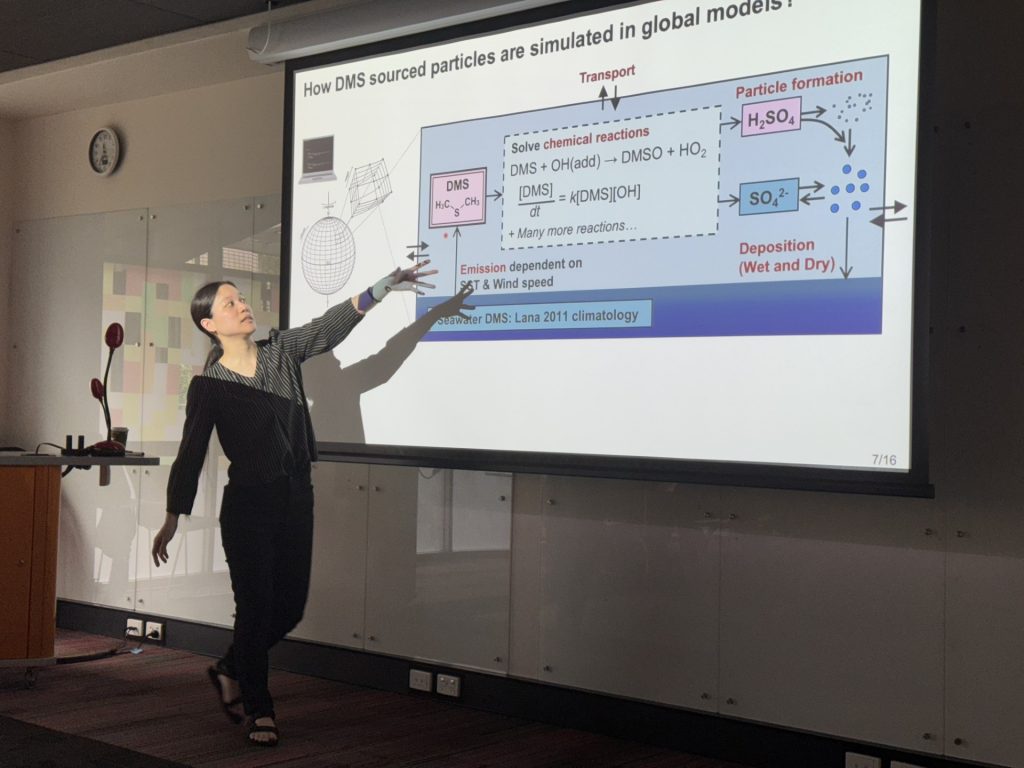
Recently, Assistant Professor Dr. Sakiko Ishino from Kanazawa University in Japan, visited QUT to evaluate sulfur concentrations in the GEOS-Chem model against QUT’s measurements from the Southern Ocean. Hosted by Dr. Jakob Boyd Pernov and Associate Professor Branka Miljevic, Sakiko spent the month of July in Brisbane using measurements from the recent MISO (Multidisciplinary Investigations of the Southern Ocean) and the CAPRICORN II (Clouds Aerosols Precipitation Radiation and atmospheric Composition over the Southern Ocean) voyages. Sakiko used measurements from QUT’s high resolution, real time, field deployable mass spectrometers, which give concentrations of gaseous and particulate sulfur species. This combination of gaseous and particulate species allows Sakiko to compare absolute concentrations but also chemical reaction pathways. Sakiko was able to show that sulfur species are greatly overestimated in GEOS-Chem compared to observations as well as diagnose incorrect reaction mechanisms. During her stay, Sakiko gave an excellent introductory lecture on the polar sulfur cycle with a focus on aerosol formation in the ILAQH group seminar.
This collaboration will continue with the QUT Center for Environment and Society funded project “Improving biogenic aerosol processes in the GEOS-Chem model using Southern Ocean and Antarctic observations and machine learning”, where Jakob will use machine learning algorithms to understand the GEOS-Chem bias in biogenic sulfur species and how it can be improved in the model.
In between office hours, Sakiko was able to enjoy the beautiful Queensland nature by participating in a clean-up of Enoggera Reservoir while kayaking.